Showing posts with label running. Show all posts

Monday, August 20, 2007

travel, running, corn snake babies and a poopy beardie

I'm on a roll. Forty one miles in 16 days. That's something a guy like me has to build up to. I had three consecutive six mile runs this week and I've had a couple of really intense threshold runs in the last couple of weeks. For those that might not be hip to the technical terms, a threshold run is where you run with an intensity that loads up your blood with lactic acid just to the point at which your body struggles to clear it out of your blood and hold it there.

It's a bit like hitting yourself with a hammer. It feels great when it's over. My point is really to say that with a twenty one mile week this week and being stronger for it, I'm learning how to do this running thing. ADHD sometimes makes it difficult to learn from my mistakes, but with the right tools it's at least a possibility for me.

PU and Boo are off to the Black Hills for the week. It's a bit of a tradition here that Mum takes the high school graduate off for a week of camping one on one. I hope they have a ball.

Last night we served 18 or so here in this tiny little place. PU put on a great spread. I over cooked the biscuits which blew bears. I was so mad. Old Joe was over celebrating his 79th birthday and as is usually the case he had a plethora of interesting tales to tell. His new $7000 hearing aids meant that the world had shifted a bit for him after 50 or so years of struggling to hear people. He's always been a good listener, regardless of the struggle to keep the messages clear. What a prize he is. Salt of the earth and all. Not an ounce of pretense about him, but a more generous spirit he has. He's still in love with PU and it's way too cute. PU was giving him a bad time about being neighbours for all these years and he's never once brought her some moon shine. What a gal.

All but two baby corn snakes have shed now. This means that it's time to try and feed them. The fun really starts now because they can be difficult to initiate feeding in captivity. I'm going to do some trials with warm roaches tomorrow from my colony of Blatta lateralis (Turkestan roach). If that's not welcomed with a big green light I'll go back to new born mice as is the proven path to success.

The beardie had another day of crapping a little and eating a little. I chopped up some carrot tops, beet greens, lambs quarters and a bit of cantaloupe that was a little grainy for human consumption and she had some of that. Apparently she should be taking most of her diet from the veggies. Just like me!

Wednesday, January 24, 2007

15th annual Polar Bear run

It's been ages I know. I've been working! Go figure.

Too much to say and I need my beauty sleep. Below is my latest project. What doesn't kill you makes you stronger right? This may be a close shave.


Below is the text from the pdf file I got last week.

============

15th Annual Polar Bear
The 15th annual Polar Bear Run is scheduled for Sunday, March
11, 2007. The run is approximately 18 – 19 miles, starting at
Husivak Road at the lake front (approx 4 miles south of Gimli)
and ending at Grand Marias. There are two start times, 8.00 am
for the 3 hr plus runners and 9.00 pm for runners who can
complete the race under 3 hours.
The run takes place on the Snowman Trail that crosses the lake,
groomed and comes complete with a warm up shack in the
middle of the lake. The trail has markers every 1/10 th of a mile
so you can keep your direction should the weather reduce the
visibility. The footing varies, some years there has been large
sheets of ice which makes it difficult to run or there has been
some loose snow which again creates problems. Generally the
footing is crusty and you don’t sink into the packed snow too
much.
The weather has varied greatly over the last 14 years, from rain
to blizzards, and from plus freezing to minus 30 degrees. We
run from west to east as the winds are generally prevailing from
the west. Conditions are checked the night before and the run
organizer will make the final decision if the race has to be
postponed. Generally speaking, the race would only be
cancelled if there were strong easterly winds, open water or
surface water on the ice. The race has been cancelled once and
postponed twice due to weather over the history of the run.
The ground support sled will carry water to replace runner’s
water bottles during the race. It is important that as much as
possible, runners carry their own water bottles and keep it in an
insulated container. During previous runs, the ground support
water supply has frozen up within the first hour and or the
supply has been extremely cold which will add to your chances
of hypothermia if it is a cold day. Also, the ground support may
only meet up with you every half hour and towards the end, this
half hour without water could be a problem if you are on the
verge of dehydration / hypothermia.
Dress warm. The best gear is a layer that is breathable but yet
wind proof. The air temperature will generally be 3 – 5 degrees
colder than the land temperature and if sunny, the sun will
create the opposite effect and cook you. The worst is starting
with a bright sun and at the end the sky clouds over and we start
getting a slight head wind off the opposite side. The
temperature in this scenario can swing 10 – 15 degrees. Most
people run on regular runners, wind pants with one layer
underneath and maybe 3 layers on their upper bodies. It would
be prudent to bring a balaclava just in case the wind changes
and you need something to protect your exposed face.
Sunglasses are important and without them you will probably go
home half blind and a splitting headache. Most runners come
home with true sunburn from the run.
Additional gear; it would be advisable to bring a compass just in
case the weather really changes and the visibility drops. One
year you would hit the incline of the opposite shore without
seeing it. Insulated water bottles and some nutrients for energy
are also recommended.
The cost depends on the number of runners. We collect a fee to
cover the cost of renting the snowmobile sled. I have found
volunteers in the past but they are usually the ones who cancel
out by the race day. I generally rent at least one sled and
blackmail my son into operating it so we know there is at least
one machine to help out. If anyone know of someone who will
volunteer, this would be great.
After the run, we meet for breakfast at Grand Beach (Tempo Gas
Bar West Beach Restaurant). Leading up to the race day, we will
use an email group list to circulate names and car pooling
information.
Attached are a couple of pics from two years ago!
I hope this provides you with enough information for now; I look
forward to seeing you soon.
Jeff Badger

Friday, July 28, 2006

4km race day!

Race #2 for me. Seems a little lame in that crowd. It was fun never the less, and tough! Running on grass is not easy! Training on gravel did not seem to count for much while running on grass that was cut long to sustain life through the drought here. It was wicked. I finished in a time of 24:14.

I took to heart that I'd be applying 95-100% of maximum heart rate through this one. I was dopey running at that intensity. I could hardly keep the markers on the correct side of me. I fumbled the turn around at the half way mark not being familiar with the routine and had to be coached against a commonly missed natural short cut. I neglected to catch my exact time either on the provided clock or my chrono. Uhg! It was still fun and it was fun to watch Pam blow away her PB for this challenging little jaunt. Pam's a friend from runningmania.com.

A small crew

race_start_750

Mike Booth out front. Winner of the last two Manitoba Marathons

group_750

Ian sucking wind at the 2km turn around

2km_750

Sunday, July 9, 2006

A must see

Land of the Gods - Legend of the Marathon

They have a good trailer for the film if this kind of thing does it for you.

I ran a blistering (for me) eight miles today. 13 kilometers in an hour and twenty four minutes. Now of course I'm coughing and can't sleep, but never mind all that, because that predicts a 65 minute 10km which puts the 60 minute barrier within reach for a race day. Yeah!

It's taken me since the new year to claw my way back to a position where that's possible. Now if I can just recover from this run without succumbing to a cold or something, I'll count myself lucky. What a brutal run!

My splits make me happy though! My last mile was 10:08 or something silly like that. My heart rate was within three of maximum on several occasions. Oh I do love it when things are intense. Even after nearly 30 years, I'm betting my parents don't miss me at all. < g > I must have been a nightmare of a kid to live with.

Thursday, April 6, 2006

Mind + Body


It's been 16 years this spring since I sobered up. It's been a hell of a ride. Running is a good thing and I think I've found myself a good coach!


From Addict To Athlete


A former drug and alcohol abuser finds a new way to get high--with exercise
by: John Hanc & Todd Crandell


My legs felt like rubber as I stumbled down the road. I was nauseous, dizzy, and disoriented. Pain seemed to radiate from every part of my body. But I had to do this-it meant so much to me. I gritted my teeth, determined that I could tolerate the agony just a little while longer. The last few miles of the 1999 Ironman triathlon in Panama City, Florida, were excruciating. My weak legs, vacant expression, and fuzzy mind were symptoms I had experienced before-in another, darker life. But this time they were not due to wanton ingestion of outrageous amounts of illegal substances.

I was blessed with just about every advantage. I grew up in a nice, upper-middle-class community, and was fortunate enough to possess athletic talent and some smarts. But I was also cursed with a genetic predisposition toward alcoholism and my own emotional problems, stupidity, and bad judgment. I hit bottom. Fist fights with my parents. Jail. Homelessness. Attempted suicide. Lots of depraved and hair-raising incidents. Some of them are almost funny, in a sick way, such as the time I got drunk in Ohio and woke up in Georgia. My life was like the old party-hearty anthem stuck on a scratch on a vinyl record: "Sex, drugs, drugs, drugs, drugs...vrrrppp...rock and roll."

Some addicts specialize. I was a generalist, and I took a perversely democratic view toward drugs and alcohol: booze, weed, coke, crack, valium. If it could mess me up, I was for taking it. During my battle with drugs and alcohol, I lost everything-my family, a promising sports career, my self-respect, and nearly my life.

In April 1993, after 13 years of this, a long binge finally brought me to my knees. I was living with my grandmother in my hometown of Sylvania, Ohio. Over the course of two days, I passed out half-naked at a Guns N' Roses concert, urinated on a Jiffy Lube manager's desk, and was arrested. A friend bailed me out and took me home. I continued consuming vodka, beer, and crack, but my disgust over the past 48 hours grew. Instead of sentencing myself to slow death by poison-my usual, self-loathing response-I began to turn the anger toward the poison itself. I started to see that if I could control that, I could control my life. And I wanted a life, I realized, not death. I cursed the booze even as I was sipping it. At noon on April 15, 1993, I drained my glass of beer and declared, "I don't want this anymore. I am done." I knew at that moment I had taken my last drink. I was suddenly determined to get sober.

Starting Over

As with everything else in my life, I jumped into sobriety with both feet. I attended Alcoholics Anonymous and Cocaine Anonymous meetings, took classes at the University of Toledo, and picked up my goalie stick again. I was 28, so the idea of playing in the NHL, a real possibility when I was a teenager, was long gone. I started running and lifting weights, and went to a hockey camp in Montreal, and in 1994 was drafted to play for the East Coast Hockey League, essentially the minor leagues of the sport. I had a decent season, but when it was over, I decided to move on. I had achieved what I set out to do: prove that I belonged, prove that I could play, prove that somewhere in this body and soul was a spark that I couldn't douse despite a decade of trying.

That December, I watched the broadcast of the Hawaii Ironman triathlon and saw competitors swim 2.4 miles, ride 112 on a bike, then run a marathon. It was exercise excess on a scale an addict could appreciate. We need to route our addictive energies into something positive and away from the craving that still gnaws at us. Training for triathlons became that for me.

My days revolved around swimming in the morning, running at lunchtime, and cycling after work. A local paper did a story about my road to recovery, and the response I received was overwhelming. Not just from people I knew, but individuals with loved ones battling substance abuse. That's when it occurred to me that instead of doing these races just to feel good about myself, I could use them to help other people. Being an ex-addict gave me credibility with addicts who were still using or fighting hard not to. I knew what they were going through and could offer them an alternative. So in 2001, I founded Racing for Recovery, an organization that promotes substance-abuse education by encouraging others to use physical activity to prevent or escape addiction.

It's now 13 years since I put down my last drink. And although I've found sobriety, I still have not found peace. Who has? Instead of worrying about where to get my next gram of coke, I'm worrying about balancing the books for my foundation and training for my next event (in April I'll be competing in my 11th Ironman in Arizona and the Boston Marathon). Now five people-my wife and four kids-depend on me. Life is as stressful for me as it is for every other adult in America. But knowing that I don't have to reach for a drink to deal with it makes me proud.

Wednesday, March 1, 2006

How do you run your best first marathon?


From my favourite running forum and my current guru.

Some Food for Thought:

Many programmes advise on the exact mileage that runners should cover when training for a marathon. This begs the question of what science tells us about the optimum training distances for marathon runners. In fact, there are few studies of the actual distances people run in training for a marathon. Thus, we do not really know what the optimum training distance is for the majority of novice marathon runners. The distances advocated in this programme have been arrived at empirically, but are compatible with the findings of a study by Grant and others.(1) When evaluating the training patterns of 88 runners in the 1982 Glasgow Marathon, Grant and colleagues found that that average distance run in training was 60km per week for the 12 weeks prior to the race, and this ranged from 24 to 103km. This study also debunked two important myths. Firstly, there is no relationship between weekly training distance and marathon time (as shown by Franklin and others)(2). Secondly, despite their apparent inadequate training, the runners did not slow down dramatically after hitting their predicted ‘collapse point’ at about 27km. Thus, they could find no evidence to support the collapse-point theory proposed by Ken Young(3). This theory holds that runners who do not train more than 101km per week ‘collapse’, and are reduced to a ‘shuffle’ when they race more than three times their average daily training distance for the last eight weeks before the marathon. Finally, as in the Franklin(2), these novice marathoners were unable to predict their marathon times accurately. However, the accuracy of their predictions did improve the closer they were made to race day. Peak Performance – Tim Noakes

One thing we all have to remember is to do what works best for us whether that is 3, 4 ,5, 6 or whatever days of running gives you the best performance results with the least chance of an injury and is compatable with your lifestyle.

Jennifer suggested marathon programs start at 50 mpw and that intensity is one way to increase your performance if you cannot put in greater miles. That is partly turn, increasing the intensity (pace) and duration (the long run) is a way to increase your performance but we always should be careful that we are not carried away by stats or myths. The common myth is to finish a marathon you need to get up to 50 mpw and this is not supported by the research or even programs such as Hidgon's intermediate that maxs out of 45 mpw and is generally less. Galloway with a 26 mile long run has 1.5 hours more of running so that again is mid 40s at the peak. If you are over 40, you can even reduce that by 25% and Higdon's master's program has a max of 34 mpw with two days of cross training.


Here are some more things to chew upon.

I found the article that stated 4 days of running per week seems to be the optimal amount to maximize your performance. This was based upon a review of research:

Hickson – increase intensity of runs, significant increase in performance. Same results with Mikesell.

Decrease intensity – significant decrease.

Decrease duration of runs – short term no effect, long time 10% reduction in performance

Reduce frequency – number of days per week from 6 to 4 – no change in performance.

Increase intensity v increase of volume – increased intensity group outperformed. (Gaskill)

Dudley, Pollock, Hansen, Wenger and Bell all found increasing duration – when you do run you run longer – increase in performance.

Dolgener – 4 or 6 days a week of marathon training – no difference.

Crews, Busso – 3 or 5 days a training per week – no difference.

Mutton – 4 days of running v 2 days of running and 2 days of cyclying – no difference.


For marathoners – elite athletes that have a greater volume of their training at higher intensity the better they did. But for novice marathoners – weekly mileage is a poor predictor of marathon performance. But as one became more experienced, the mileage became a better predictor.


King – 3 days a week of high intensity out performed those who trained at lower intensity for 5 days a week over a 2 year period.


Lies, Damn Lies and Stats: Most of the above noted studies had between 70 – 250 people. So we are talking about broad generalizations that clearly do not apply to everyone. Plus the biggest point we may miss is that studies show us how to maximize our performance BUT generally never discuss the risk of injury. I read one study that sort of did: Those only do interval training in the short term out performed those who only did farleks and those who combined both approaches but the those who combined the approaches did better in the long term because the interval only people had a higher rate of injury. Doing a 20 mile run with two or three other runs at high intensity may allow one to increase their performance IF they get to the starting line plus who knows what the accumulated effect of all this will be. Plus, just because it is the best thing to do may not make sense when lifestyle is also considered. How many can afford to run so hard 3 or 4 days a week that for the rest of the day we run plus some other time is reserved ONLY for recovery.


Consider this with the discussion of genetics – at best our performance can be effected 45% by our training but most studies seem to suggest 25% or so. We also know that a fairly healthy person can run 20 miles. With proper pacing and hydration, how much training is required to get one to the finish line, to the finish line with a smile, to do the best they can do? No one really can answer that. Training programs based upon successful elite athletes might give us a clue, but then again, it would seem the mileage only really matters when you are an experienced elite athlete but even then it has to be the right mileage – the proper long run, the proper intensity.


This was written to say if you believe you are just muddling through and unsure, guess what, so is everyone else. There seems to be agreement that at least 3 days of running a week is necessary. That the long run is important and one should try to get to at least one run of 30 K. If you want to finish a marathon faster you will have to run faster in training but the risk is a greater chance of injury. No point in being able to run a 3:30 marathon if you on crutches the day of the race. As a novice if you missed that 8 K run or added an extra 20 K run, no one will be able to tell you your time, but with your training you stand a better than 90% chance of finishing the marathon.
_________________
"Run like hell and get the agony over with."

Tuesday, February 28, 2006

Prepare yourself as this is no ordinary race. . .


Early bird deadline - March 1st, 2006
So don't delay! Your entry fee goes up by quite a bit tomorrow.


The Canadian Death Race: Are You Tough Enough?


Sunday, February 26, 2006

Covering the bases


Apparently I've joined the 95th percentile of runners over 40 (now pushing 47) that haven't been injured in their first year of running. I have other hurdles to jump, but injury isn't one of them yet, fortunately. I keep finding articles about injury, genetics and their impact on athletes interesting.


Simple Rule: Run Smart


A marathon training schedule for the non-specialist, which has been tested in the lab and on the roads

balance

I lead an active life. It's often difficult for me to gain a detached view of a larger picture. This conversation has brought me a long way along a good road.

Pam's friend John is likely close to finishing the Winnipeg Hypo-half as I write this. He's wearing what was going to be my bib and although it stings a little still, I'm on firmer ground now.

On rising this morning I was clear on what goals are ahead. I got to the Santa Shuffle accidentally in the best shape I've been in for twenty or more years. I felt empowered, relaxed and confident in my abilities.

The major hurdles of running a marathon are for me, getting enough miles in to avoid crumpling like a cheap suit when my muscles run out of fuel. The mental aspects are another matter, but coming to the start in strong condition is what I'm after.

Whether it be a short race or a long one, I'm there to celebrate whatever genetics I bring to the table.

The things I want to sacrifice for running are lifestyle choices that are long over due. The devil is in the details though. I believe I am hard wired to resist change. It may be a coded norm to keep groups stable and more likely to survive, I don't know. I do know that changing, independent of surroundings is difficult like nothing else. Slow learner maybe. :P

There maybe times where I set aside a block of months to make room for more running, but not now. There are too many signals of warning through others examples of the threshold being much lower than expected for a 47 year old new to the game. I've got lots of time to adapt if I remain healthy and I have a whole lot to learn about leaving myself a maximum of health to recover with.

If and when I can play on a higher level than that from a position of strength, then maybe I can take the time to formalise a training program, worry about times, race for something other than the thrill of participating with birds of a feather and bear down on training more heavily.

With limits below 20 miles a week, I'll now try and gain some experience with recovery, with the aim to learn how best to recover most strongly. I've played with the application of the stress now for a year and a half but have always put the stress above the recovery.

The pendulum swings.

Saturday, February 25, 2006

Life without orange juice


Lactate Testing - Basic Concepts


Are you plagued with thoughts that go something like, "How will I ever tell if the training I'm doing is improving my performance?" Well, me too!


Accusport has some good testing ideas.


So does Peak Performance. High-speed running tests are excellent predictors of marathon finishing time

Tuesday, February 21, 2006

reality check

I'm getting old and can't ignore as much of the everyday stresses as I once could.

I'm working on the third week back into gear. I haven't been able to get beyond the 20 mile per week threshold without my immune system showing signs of stress, so some things will have to change.


Sleep is the primary impediment to progress and the one I'm focused on most. Second to sleep would be diet. I have a fast metabolism, but tend to over eat and that bogs me down tremendously.

The strategy lately has been to establish a lower threshold and work to have strong resulting recovery by having a better sleep pattern and a lighter diet. I want to bring strength training back in regularly too, so although my mileage is way down, I'm taking two days a week to pound the core strength work.

So far it seems to be working. I got a lot of animals out of the house which helps keep the allergic responses down to a minimum. I love animals around me, but push has come to shove. I retained a small young budgie to tame and I'm picking up a yearling snake later this week. Might have an adult coming as a rescue animal later in the week, I don't know yet. Excited!!!

Monday is core strength.

Tuesday is 2 mile running.

Wednesday is off.

Thursday is two miles running.

Friday is core strength.

Saturday is off.

Sunday is 2 miles running.

I'll do this until I can see myself getting stronger in mood, resiliency and fitness. Once I can get that bit of self preservation looked after, I'll add another 2 mile run to make it a four day a week event or maybe simply extend the Sunday run to be a long one.

It may be necessary to not have a four day week plan for running in order to ensure a strong recovery between runs. So much depends on the quality of rest.

I've been reading and thinking a lot about training focused on recovery rather than the stimulus of the workout itself. The thought being centered around a workout not being much use in advancing my fitness if I'm not applying the stress from a position of strength.

From my immune system's response to the 20 mile week, I'd say it's all about recovery. If I can recover strongly, then applying a stress to the system will force it to adapt, but if not, I just realign myself with the ditch again.

I knew this running thing would push me to new levels of understanding about how best to care for myself. It's working. I hope by beginning again and approaching a long steady curve toward higher mileage, I can reach my goals and still retain the other activities I enjoy. That 24 hours in a day rule blows.

This all is a blow to the ego, but so much better than walking away. Square one again, but a little wiser.
Cheers!

Wednesday, February 15, 2006

Nutrition


Basic "on the run" nutrition and hydration guidelines

Pre-run:
Consume 25-50g carbs 1-2 hours before exercise. Try an energy bar, bowl of cereal, bagel, fruit...your usual diet. Drink 8-16 oz. of water or combine with the above in a carbohydrate drink.

During run:
Consume 25g carbs for every 45 minutes of exercise. Go for a gel pack. They typically contain 25-30 grams and are easy to digest. Drink 4-8 oz. water or diluted sports drink for every 15 minutes of exercise.

Post-run:
Consume 25-50g carbs immediately after exercise. This can be a combination of food and drink. Of course, you will need to re-hydrate with water while eating an energy bar, bagel, or some form of carbohydrate. Or, you can drink 25-50 grams of carbohydrates in a sports drink if you have a hard time eating right after a workout. Begin drinking 16 oz. of water for every pound lost during exercise. Continue to drink water throughout the day. Consume another 25-50g carbs 30 minutes after exercise. Consume 50-100g carbs and 20-40g protein 1 hour after exercise. This is a good time to eat a well balanced, sit-down meal. Soup and a sandwich, salads, whatever suits your tastes. Chicken and tuna are great sources of protein. Consume 50-100g carbs per hour and 20-40g protein every 2 hours. Continue to do this for 6 hours after your run. You will find that by following this routine, especially on your long run days, you'll feel refreshed rather than exhausted after your workout.
Read the source...

Still hiting the ditch pretty regularly.


I thought this was pretty tight. This rings true to me


From the March issue of "Running Times" by Pete Pfitzinger:

Training leads to fatigue that in turns leads to recovery and that in turn leads to supercompensation. Thus with the right combination of type, duration and intensity of training, the body "adapts" to a higher level. The supercompensation is the accumlated result of training.


One needs the optimal balance with 2 - 3 hard training sessions per week even though it takes 5 - 10 days to completely recover from a hard session (and I have read elsewhere up to 30 days for a run of > 18 miles). It is also interesting that it takes at least 10 days to obtain the full benefit of a workout - something to keep in mind when during the taper you believe you need one more long run, one more full tempo ru, one more set of hills in the last week or so before the race.

How long to train: It takes at least six weeks for results to show up through lab testing so Rome (marathon) was not build in a day. Also something to quite in mind because of all of the recent threads about how discouraged people are after their first ''long' long run.

So what is the prefect balance because training and recovery: The bad news is that GENETICS will be the one number determing factor. (Health, lifestyle and current level of training are also factors). A huge factor when thinking that you are not doing as well as person "X" because you may be one person who simply adapts slower and needs more recovery.

So the key points seem to be:

1) 10 days at least is required for training to obtain the full benefits of training.

2) 6 weeks at least to show improved performance.

3) The right mix of intensity, duration, type of runs and recovery is dependent upon the genetics of the individual.

Monday, February 13, 2006

Inspiration on so many levels


Dean Karnazes wrote a wonderful book about his rise through mid life. It's called Ultramarathonman. It works on so many levels that you need not have any interest in running or mid life to appreciate this man's journey.

Friday, February 10, 2006

Cheryl Bartmanovich

Cheryl is an active member of the runningmania.com message board. I met her first on the running room board before the heavy hand of censorship drove many to seek refuge elsewhere, but I digress.

I first met Cheryl with a crew of other mainiacs at my first road race earlier this winter. She loves to have fun and she's been having some more with a trip to Dr. Phil and now to Oprah. She's got quite the story and remains a humble kind woman.


Oprah's follow ups show


Winnipeg Sun - Runner shed 100+ lbs. - content below.


A Manitoba woman who lost more than 100 pounds through marathon running has shared her story with Oprah Winfrey.

Interlake resident Cheryl Bartmanovich flew to Chicago a few weeks ago to make an appearance on The Oprah Winfrey Show. Her interview with the talk-show superstar is scheduled to air today.

Bartmanovich's appearance comes almost two years since she saw Oprah's interview with Wynonna Judd about her struggles with weight -- an interview so inspiring, the then-265 pound 44-year-old bought a treadmill.

TRAVELLED FAR

"Almost a year to the day, I ran my first half-marathon," Bartmanovich said this week.

The mother of two from Lake Francis -- about an hour's drive north of Winnipeg -- has traveled far both physically and emotionally in the last two years.

She's done six half-marathons and a full 26-mile challenge since she decided to buy a treadmill, dropping more than 100 pounds through a rigid running schedule and what she describes as a "sensible" diet, limiting breads and loading up on veggies (but banning potatoes of any sort).

Bartmanovich has fond memories of the first time she went to her husband's company's annual holiday bash after her transformation. She said it took a few hours to realize his long-time co-workers weren't ignoring her; they were having a tough time figuring out who he'd brought.

But better than wearing a slinky black dress to a Christmas party -- and weighing less than she did when she got married -- was the feeling of finishing her first full marathon alongside the world-famous Waikiki Beach in Honolulu, Hawaii.

"A fantastic place for a holiday but a little warm for a Manitoba girl like me to run a marathon," she said.

Producers for Oprah's show first spotted Bartmanovich about a year ago, when she appeared on Dr. Phil. Bartmanovich credits, in part, advice from a book written by Dr. Phil McGraw for encouraging her to get into shape.

She said having the chance to talk with Oprah, who she described as "down to earth," was a once-in a-lifetime experience.

"It was an experience I'll never forget," said Bartmanovich. "When you meet Oprah in person, she's exactly the same."

It's expected Bartmanovich's appearance will include a segment where a personal letter from Judd to Bartmanovich is read.

But Bartmanovich sounds most excited about her next trip. She plans to head to Phoenix, Ariz., for an Arthritis Society fundraising marathon -- a charity close to her heart since her father and a close friend suffer from the disease.

"I'm running for those who can't, and hopefully making a difference," Bartmanovich said.

Monday, January 16, 2006

Haile Gebrselassie shattered the world half marathon

TEMPE, Ariz. (AP) -- Haile Gebrselassie shattered the world half marathon record by 21 seconds Sunday while running the last half of the Rock 'N' Roll Arizona marathon.

He also broke the 20-kilometer world mark en route. It marked the 19th and 20th times the diminutive Ethiopian has broken world records in his career.

"This one is so fantastic because this is my first one in America," he said. "It's a little special to me. It's really, really wonderful."

His half marathon time of 58 minutes, 55 seconds on a clear, crisp morning through the streets of Phoenix, Scottsdale and Tempe broke the mark of 59:16 set by 18-year-old Kenyan Samuel Wanjiru in Rotterdam, The Netherlands, last Sept. 11.

His 20-kilometer time, also officially clocked, was 55:48. That broke the world record held by his longtime rival, Paul Tergat of Kenya, of 56:18 set in the Stramilano, Italy, half marathon on April 4, 1998.


While nearly 34,000 took part in the marathon and related running events on Sunday, only Gebrselassie and four pacesetters took off from the midpoint of the marathon course. Initially, he was slower than Wanjiru's world-record pace, but that changed when the 32-year-old four-time world champion and two-time Olympic gold medalist took off on his own some 10 kilometers into his race.

That was by design, he said.

"That was our plan. We didn't expect the first part of the race to be fast," Gebrselassie said. "Our plan was for the second part. My plan was to run under 59 minutes and that is what we did."

With rock bands playing each mile along the way, Gebrselassie showed no signs of laboring, looking as if he was on a simple morning run. He averaged less than 41/2 minutes per mile over the 13.1 miles.

Gebrselassie won the Olympic gold medal at 10,000 meters in 1996 and 2000 but has not run on the track since his fifth-place finish at the 2004 Athens Games. Instead, he switched to the roads, where he hopes to add a gold medal in the marathon at the 2008 Olympics in Beijing.

Wednesday, January 4, 2006

Year in review

550 miles - 885 kilometers run.

First race in the bag.

81.5 miles - 131 kilometers run in December. :D Yeah Baby!


Thank the gods for huge toe boxes! Now if I could just find a pair of skates to match the roomy thang!


Tuesday, December 20, 2005

marathon training

Excerise caution in marathon training Running's holy grail can be the experience of a lifetime, but use common sense: experts
By ANDREA BAILLIE

TORONTO (CP) — Audacious would-be athletes who plan to add “complete a marathon” to their list of new year’s resolutions should exercise caution and common sense, say running experts.

“Goal setting is really important because you don’t want to set an unrealistic target and then be disappointed and even hurt yourself,” said Bruce Kidd, a former Olympian who is now dean of the faculty of physical education and health at the University of Toronto.

“That’s true of any participant in physical activity — whether it’s someone just starting out or it’s someone entering the Olympics.”

In recent years, marathons have become a matter of course for baby boomers seeking an ultimate fitness experience.

Celebrities have also got in on the act, with megastars like Sean (Diddy) Combs and Oprah Winfrey extolling the life-altering virtues of a 42.2-kilometre run.

But the marathon boom has also brought a new hurdle: many people aiming for running’s holy grail are simply not prepared to complete such a gruelling task.

Case in point: the popular Toronto running group JeansMarines was recently banned from the 2006 Marine Corps Marathon in Washington.

The move came after group founder Dr. Jean Marmoreo was accused of helping some runners take a shortcut to shave about 6.4 kilometres from course so they could avoid disqualification at this year’s event.

While participants at the event are required to cross the finish line in under seven hours, one race organizer said some of the JeansMarines runners were on pace to do it in a whopping 13 hours.

That left some in the running community questioning if the runners belonged at the event in the first place.

Marmoreo’s husband, Bob Ramsay, says JeansMarines — whose motto is “Yes ma’am, you can do a marathon” — learned a lesson from the ordeal.

“One of the things we’re doing is we’re saying ‘Look . . . you who are coming off the couch, are of a certain age, may be pretty overweight, this year would be best if you made a half marathon your goal.”

Experts say a more moderate approach to running can sometimes reap greater long-term benefits than the exhaustive do-or-die training involved with a marathon.

“You’d like to think that people are doing this on the way to an ongoing regular, lifetime fitness program,” said Running Room founder John Stanton.

“The ideal of all or nothing (goes) against that. A marathon is a high, but you don’t want it to be such an emotional and physically challenging event that you’re never going to run another step again.”

For those who are intent on going the distance this year, experts agree that the first order of business is a visit to a doctor.

“Unfortunately, people die at marathons,” said Jay Glassman, founder of the Toronto Marathon.

“It’s not that running is dangerous or contributes to the cause, but . . . there are often underlying medical issues that people might have.”

After runners receive a clean bill of health, they may want to consider a combination of walking and running to help them reach the finish line.

Marathoning guru Jeff Galloway swears by such a strategy and has developed a formula that uses a runner’s pace to determine what ratio of running and walking will best work for them.

“The biggest problem I see is people getting a base of fitness and then pushing the envelope too far,” he said in a telephone interview from Atlanta. “And the other component is to put enough walking into the mix.”

Adds Kidd: “It seems to me that the main thing is to keep going. It’s hard sometimes, but you’ve got to learn that if you’re in a bad patch, you hit the wall ... you can still keep going if you’re properly trained and so on.

“Walking is one way to do that.”

For those brave souls who do manage to run, walk or crawl to the finish line of a marathon in 2006, Galloway is convinced the experience will remain with them for a lifetime.

“I’ve advised over 200,000 runners. There has been nothing that I’ve seen or been told about from these people that has given the (same) sense of satisfaction and achievement as finishing a marathon,” he said.

“I hear from people that are CEOs of big companies, famous people, folks that have done it all, and the thing you’ll see on their office wall above all others is a T-shirt or a medal (from) the marathon they ran.

“There are certain accomplishments that you have to do yourself and this is one of them.”

Sunday, December 4, 2005

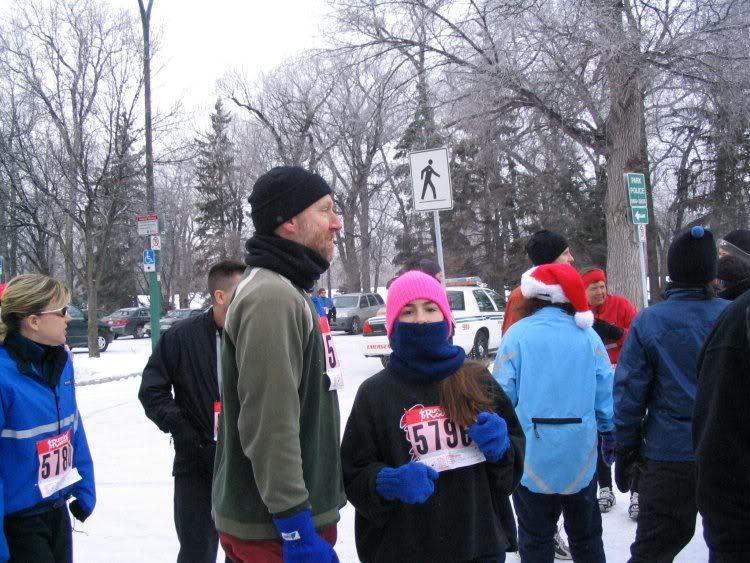
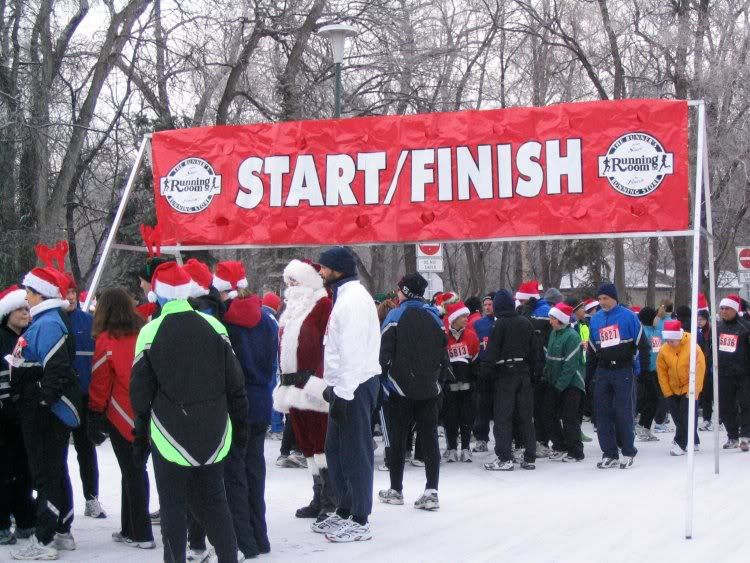
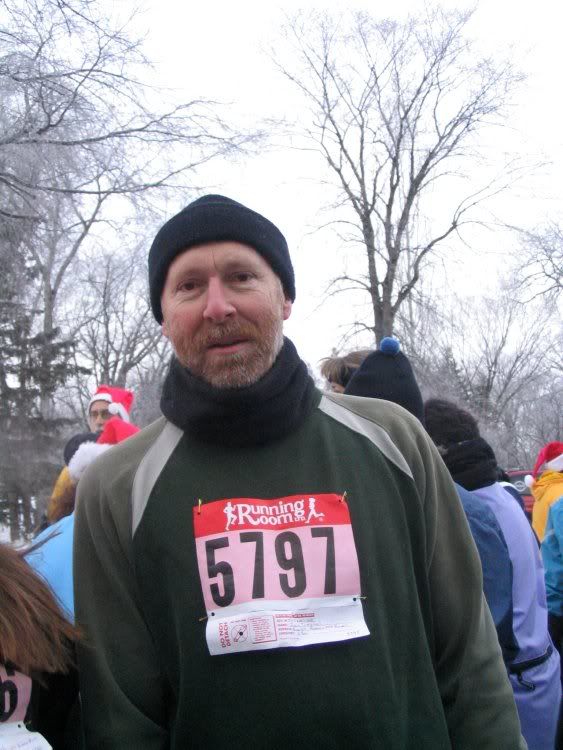
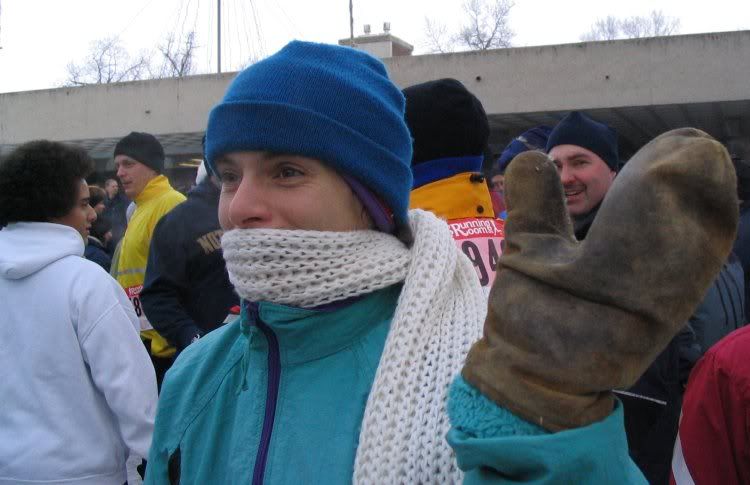
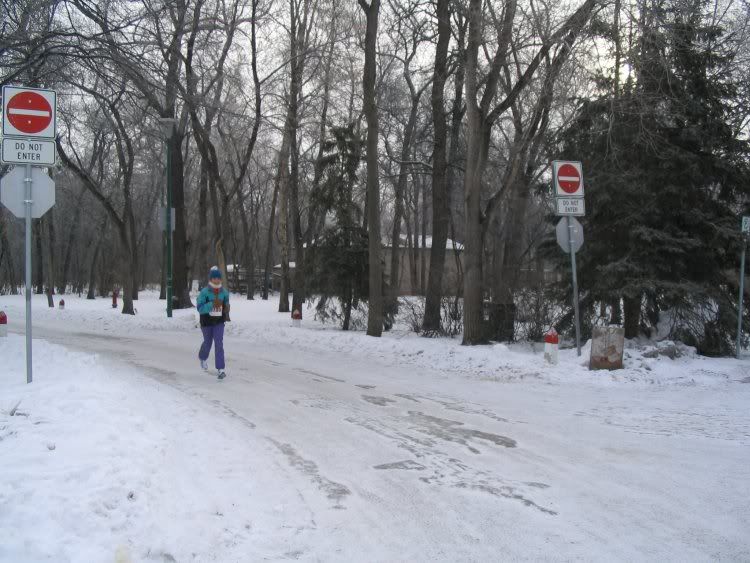
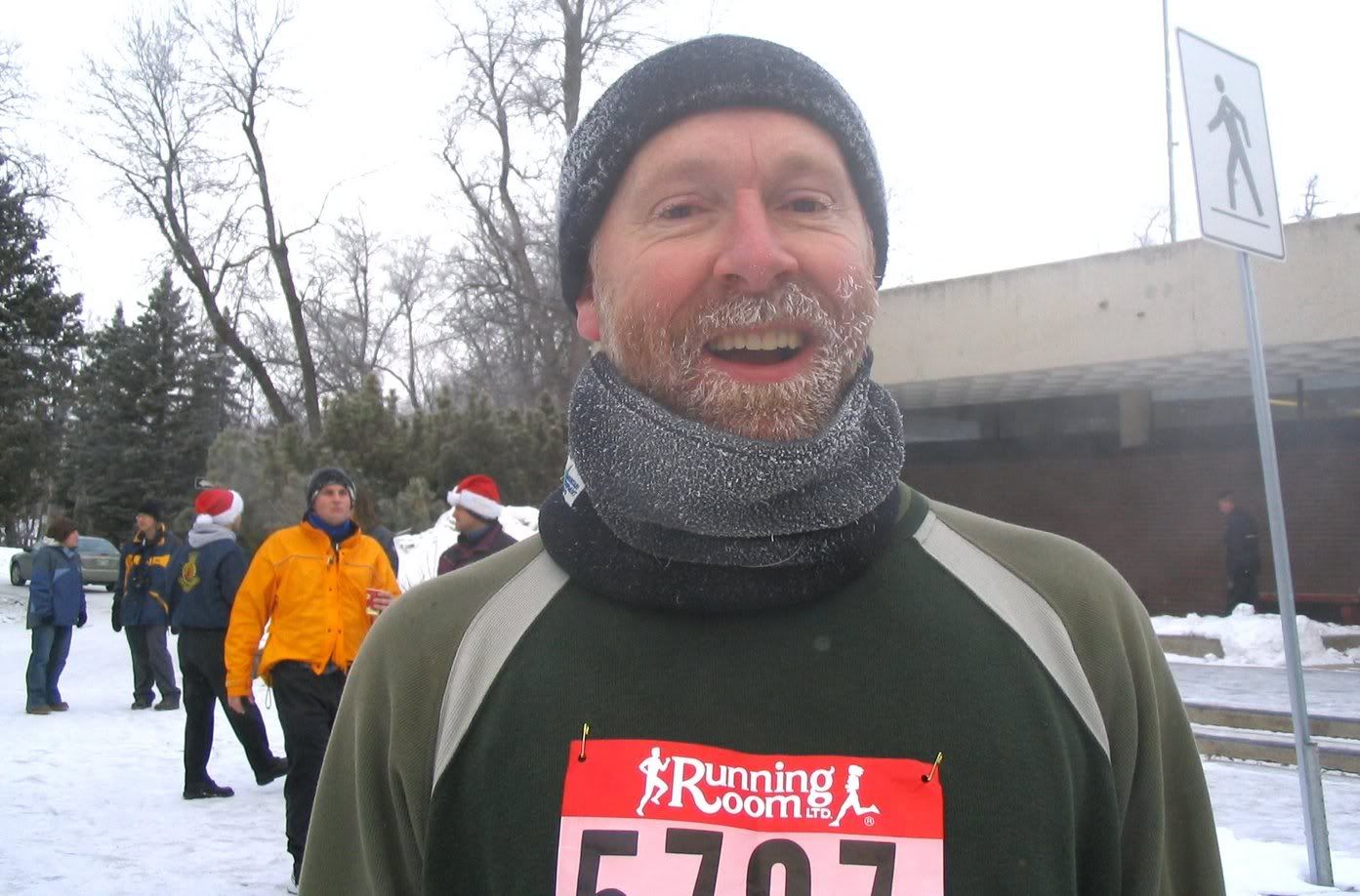
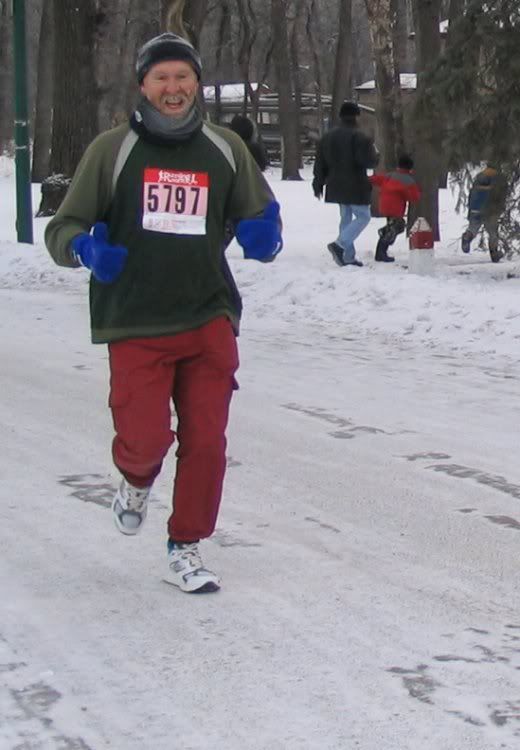
5km Santa Shuffle - Winnipeg 2005

Some images of the day. Click on the thumbnails for a closer look.


Saturday, December 3, 2005

Winnipeg Santa Shuffle

27:52

5:34 min/km

8:58 min/mile

The 5km was broken into two equal loops and a third short one. I ran the first loop at about 85% and the second one at about 92% and the third short stint at 98%.

I dressed perfectly and it was cool this morning in the hoarfrost, overcast and about -16C or so I think. I warmed up for 10 minutes prior and that seemed wise in retrospect. It helped me to focus on my pace with which I've struggled.

That was fun. I've been watching DrJ's (runningmania.com) spin on fun when it comes to racing, and I was so very convinced it would be hellishly difficult to endure but, surprisingly, I was at home there. It was intense, yes, but it was fun. It demanded all my attention and I enjoyed it all. I've never raced before and the energy generated with all the other runners around was infectious in all the right ways.

After so many miles alone, it was nothing short of thrilling to be in the company of others that know the joys of running. I could drag this feeling out for pages, but I'll spare you.

I met Cheryl (Dr. Phil celeb) for the first time today and was struck by the contrasts between my feelings of euphoria and her congested energy backing up on a taper that she's built toward for so long. She has her first marathon in 8 days. I kept thinking that what she is headed for would be absolute bliss. The degree of deferred gratification in training for a marathon is something beyond my ability to reason through, but if it provides any part of the feelings I carry today, it's something I want to jump in with both feet for.

For now a half marathon at the end of February will have to do.

I'm more than a little embarrassed that I wasn't more conscious of others and their requirements for support. I was wholly distracted with my own elation, which leaves me feeling a little childish now. The seasoned veterans of race day like Jill, Dwayne, Natalie, and Cheryl were so kind and indulgent of my new thrill. It was tremendous to have other runners to share the experience with. I'm still a little giddy.

Dwayne's Running Room 5km clinic crew were a good bunch. A friend and I joined a table for lunch at Stella's with two of them. Diana and... I'm so bad with names! The conversation was lively and the food was wonderful.